

You are here
Back to topCalifornia Almond Industry Reaffirms Long-Term Commitment to China Market
June 05, 2026



At the 19th China Nut and Dried Fruit Food Exhibition, which took place from April 16 to 19 in Hefei, Anhui province, Emily Fleischmann, vice president of global market development at the Almond Board of California, presented an overview of California’s almond sector. In her talk, Fleischmann outlined the industry’s latest market dynamics with a focus on its long-term strategy in China, including trade relations between the United States and China, export performance to China, regulatory compliance, current growing conditions, water management and ongoing nutrition research.
Notably, during her presentation, Fleischmann announced that the General Administration of Customs of China had renewed the registrations of all 66 almond handlers wishing to export to China.
On the topic of trade relations between the two countries, Fleischmann said that the essence is mutual benefit, with agriculture serving as a cornerstone of decades of cooperation. She added that the Californian almond industry remains committed to sustaining this partnership and continuing to promote bilateral exchanges and open markets. It is also closely monitoring the implementation of the GACC’s Order No. 280, which takes effect on July 1, 2026, and replaces Order No. 248 as the new regulatory framework governing the registration of overseas food manufacturing facilities.
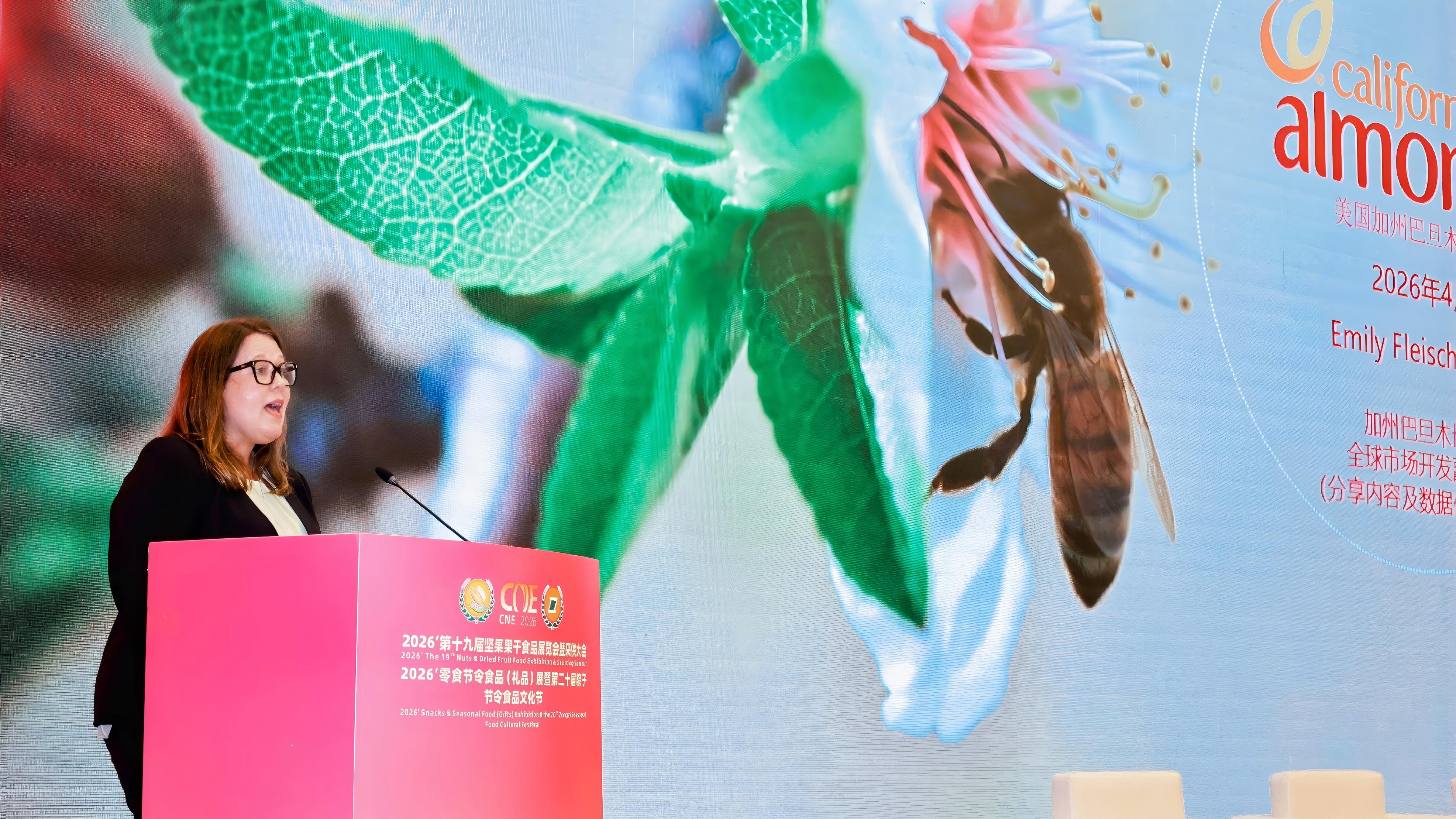
Although China was once among the most promising growth markets for Californian almonds, exports have declined in recent years on account of unfavorable trade policies. Fleischmann said that the board is continuing to emphasize the importance of the Chinese market to U.S. policymakers with the goal of restoring and expanding access.
California’s almond acreage now stands at 1.5 million acres, with the bearing acreage stable and no near-term changes expected. The state has 7,600 almond farms, 90% of which are family-owned and 70% of which are 100 acres or smaller, many operated by multigenerational families. The Mediterranean climate of California’s Central Valley provides ideal growing conditions for almonds, which account for about 80% of the global supply.
In terms of water management, the industry has made continued progress: water use per almond dropped by 3% between 1990 and 2010 and by an additional 15% between 2018 and 2022. California is also home to a significant share of all Bee Better Certified farms in the United States, and almond orchards provide bees with their first food source of the year, with beekeepers reporting that colonies leave orchards stronger.
California’s advantageous climate and soil characteristics, multigenerational growing experience, and one of the world’s strictest food safety systems allow Californian almonds to maintain consistent quality. Over the past 30 years, almonds have become the most researched nut, with ongoing studies confirming their nutritional value. The market now offers 14 different forms of almond products for diverse processing and consumer needs.
Despite trade policy challenges, the Almond Board of California reaffirmed its enduring commitment to the Chinese market, pledging continued investment in strategic partnerships, nutrition research and consumer education to increase the consumption of almonds in China. Fleischmann also noted that a growing focus on healthy snacks among Chinese consumers positions almonds — a nutrient-dense and versatile nut — for long-term growth potential.
Images: 19th China Nut and Dried Fruit Food Exhibition

Regions:
Produce:






-
September 22, 2026
-
September 21, 2026
-
September 20, 2026
-
September 18, 2026
-
September 17, 2026
-
August 24, 2026
-
August 25, 2026
-
August 28, 2026
-
August 24, 2026
-
August 27, 2026
Upcoming Events

Featured Produce

Produce Marketplace
- ElGhouati Crops · Morocco
- ElGhaoutiCrops · Morocco
- Elangeni Food Group · South Africa
- Hainan ITG Logistics · A26,Haikou
- Joshua Lim · Malaysia
- City fresh fruit co. · Thailand

Add new comment