

You are here
Back to topChina Remains Top Market as New Zealand’s Apple Exports Rebound
November 11, 2026


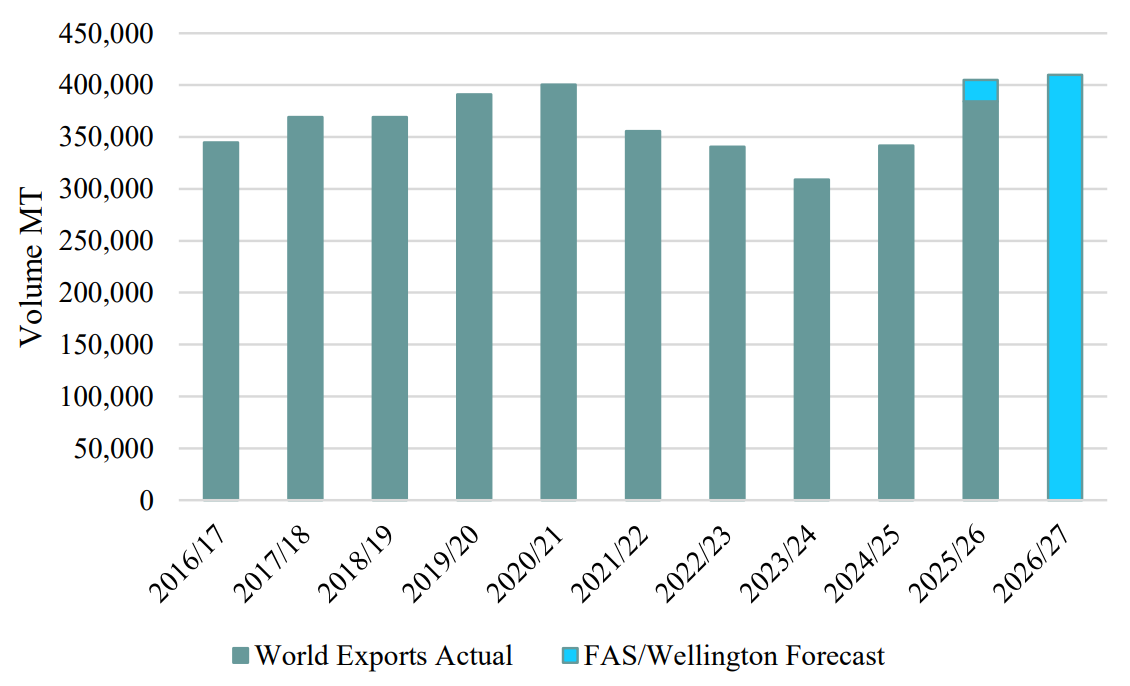
New Zealand’s apple industry is staging a strong recovery after being hit hard by Cyclone Gabrielle in February 2023. In a report released on Oct. 22, the U.S. Department of Agriculture’s Foreign Agricultural Service forecast that the country’s commercial apple production would reach 590,000 metric tons in the 2026/27 season (January to December 2027), while exports are expected to recover to 410,000 metric tons, the highest since 2020/21.
China remains New Zealand’s largest apple export market. Shipments to China rose from 41,954 metric tons in 2023 and 64,788 metric tons in 2024 to 82,422 metric tons in 2025. From January to August 2026, exports to China totaled 91,349 metric tons, up 17.74% from a year earlier.
Production Recovering
The report estimates an apple planted area of 11,250 hectares for New Zealand in 2026/27, with 10,900 hectares harvested to give a commercial apple production of 590,000 metric tons. Although only slightly above the 585,000 metric tons estimated for 2025/26, this continues a rise from 555,000 metric tons in 2024/25 and would be the second-largest crop on record, in line with pre-pandemic levels.
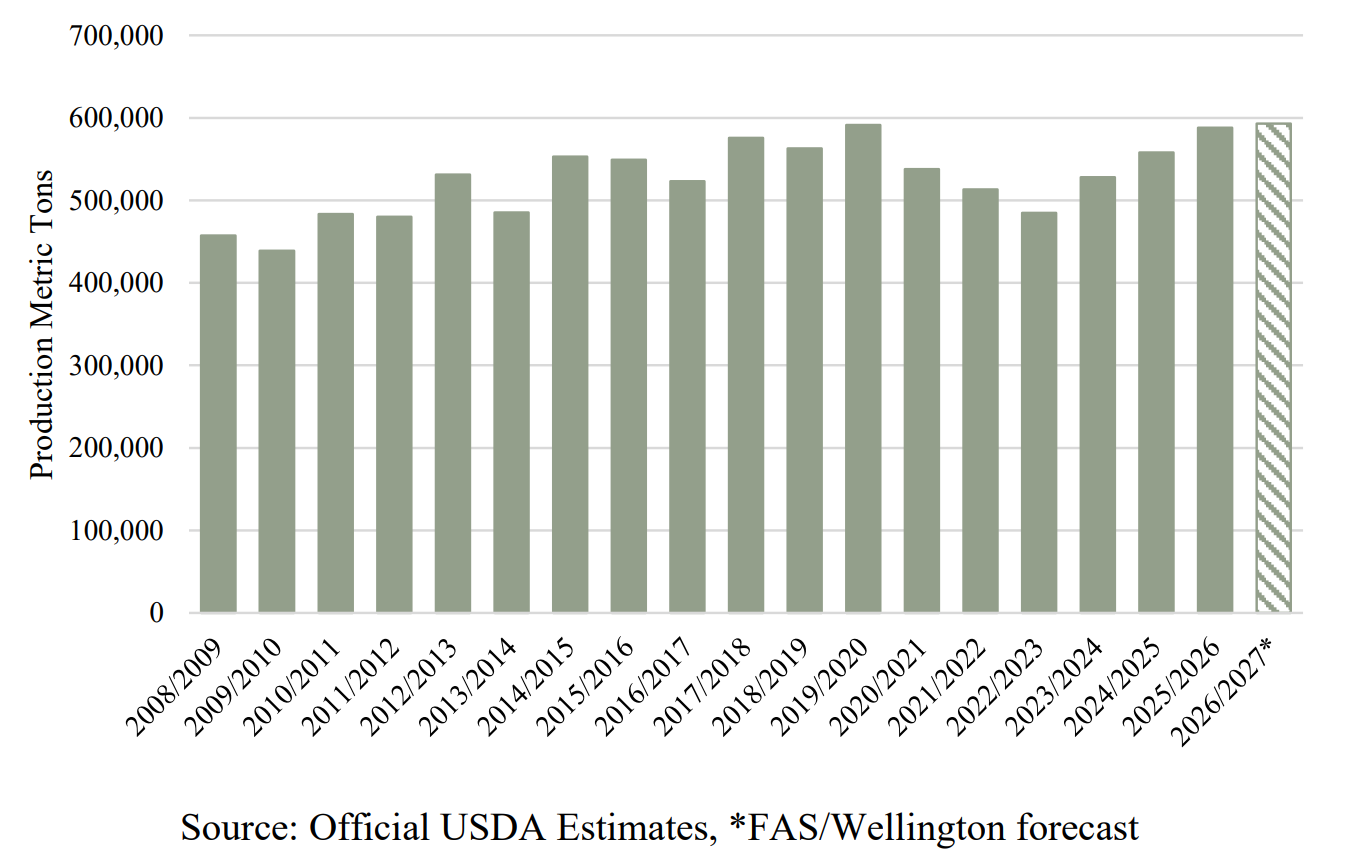
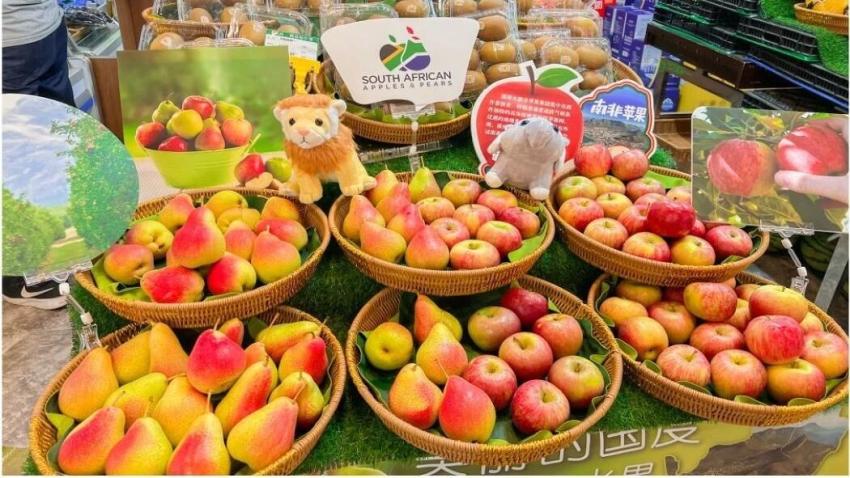
The report attributes the recovery to young orchards planted since the cyclone reaching maturity, as well as growers moving away from lower-returning traditional varieties such as Braeburn toward premium specialty apples such as Envy, Dazzle and Fuji. Correspondingly, Braeburn’s share of planted area fell from 22% in 2011/12 to less than 4% in 2025/26.
Hawke’s Bay, on the North Island’s east coast, remains by far the largest growing region, with 65.4% of the planted area. Next are Tasman at the top of the South Island (22.8%), Gisborne on the North Island’s east coast (5%), Otago in the southern part of the South Island (4.2%), Canterbury on the South Island’s east coast (1.6%) and the Bay of Plenty in the northeast of the North Island (0.9%).
El Niño Weather Risk
The report notes that New Zealand is heading into the 2026/27 summer under a very strong El Niño. Earth Sciences New Zealand expects El Niño to dominate weather patterns through spring and early summer, bringing more frequent and stronger westerly winds and greater weather variability.
The effect is expected to differ between east and west. Eastern growing regions such as Hawke’s Bay, Canterbury and Otago are more likely to see warm, dry weather with rainfall near or below normal, while western and southern areas are set to face more frequent rain. Prolonged dry spells, strong winds and temperature swings could raise production costs and affect fruit quality.
Exports Led by Asia
The report forecasts that New Zealand’s apple exports in 2026/27 will reach 410,000 metric tons, an increase of 5,000 metric tons from the revised estimate of 405,000 metric tons for 2025/26 and the highest since 2020/21.
From January to August 2026, exports totaled 385,840 metric tons, up 5.98% from a year earlier. According to the report, export revenue for 2026 so far is about 1.25 billion New Zealand dollars (US$695 million), the highest on record, with some volume still to ship.
Mainland China was the largest market at 91,349 metric tons (+17.74%), followed by India at 50,657 metric tons (+33.76%), Taiwan at 44,824 metric tons (+3.95%) and Vietnam at 42,283 metric tons (+10.75%). Exports to Hong Kong rose 48.44% to 20,318 metric tons. Meanwhile, shipments to the European Union and the United Kingdom fell by 52.09% and 17.16%, respectively, and shipments to the United States fell by 4.31%. Overall, gains in Asian markets more than offset the declines elsewhere.
China Remains Top Market
New Zealand’s apple supplies to China are increasing and demand is strong. Based on year-to-date trade data, China has accounted for 23% of New Zealand’s apple exports, making it the largest market for fresh apples.
New Zealand is leveraging its extensive network of free trade agreements to maximize its competitive advantages, and the U.S. Department of Agriculture expects exporters to focus on Asian markets, particularly Vietnam, India and China, in the coming year. Exporters also plan to market specialty varieties in counter-seasonal Northern Hemisphere markets such as the European Union and the United States.
Royal Gala remains the mainstay of exports, but demand is rising for specialty varieties such as Envy, Dazzle and Fuji, which should give Chinese consumers a wider choice of New Zealand apples. For the China market, New Zealand’s return to full production means more ample supply and stiffer competition on quality.
Images: Pixabay (main image), U.S. Department of Agriculture (body images)
Topics:
Regions:
Produce:



-
November 11, 2026
-
November 11, 2026
-
November 10, 2026
-
November 09, 2026
-
November 09, 2026
-
October 20, 2026
-
October 19, 2026
-
October 21, 2026
-
October 27, 2026
-
October 14, 2026
Featured Produce

Produce Marketplace
- Pujiang Tangguo Agri · China
- Pujiang Tangguo Agri · China
- ElGhouati Crops · Morocco
- Hainan ITG Logistics · A26,Haikou
- Joshua Lim · Malaysia
- City fresh fruit co. · Thailand

Add new comment