
China’s Pecan Production Doubles to 12,000 Metric Tons [1]
Submitted by Momo [2] on
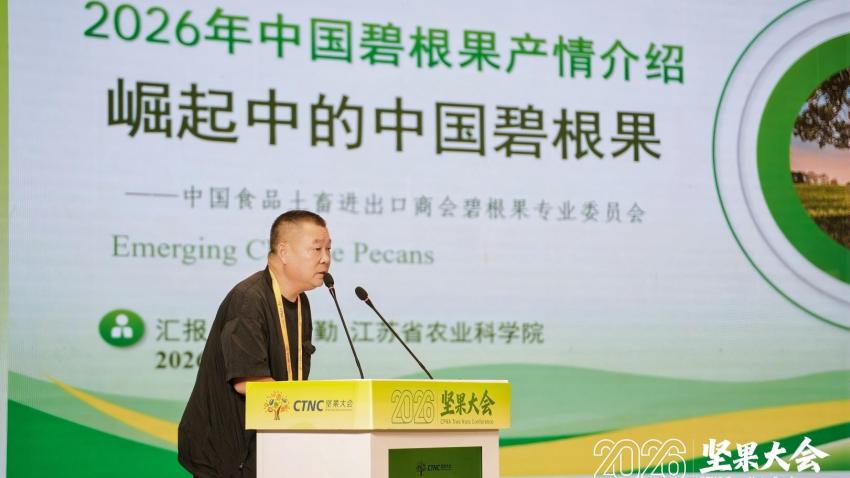
At the 2026 CFNA China International Tree Nuts Conference [3], the Pecan Committee of CFNA released its 2026 China Pecan Industry Report, offering a comprehensive review of current consumption, import/export dynamics and planting distribution, while laying out a clear roadmap for industrial upgrades. According to the report, China’s domestic pecan industry [4] is entering a critical window of rapid growth.
China’s pecan consumption currently relies heavily on imports [5], with total annual demand reaching approximately 66,000 metric tons. Over the past eight years, the country has imported an average of more than 54,000 metric tons of pecans annually, with kernel products accounting for 60% of total consumption. Last year, domestic output stood at 6,200 metric tons. This year, however, production is projected to double to 12,000 metric tons (kernel basis).
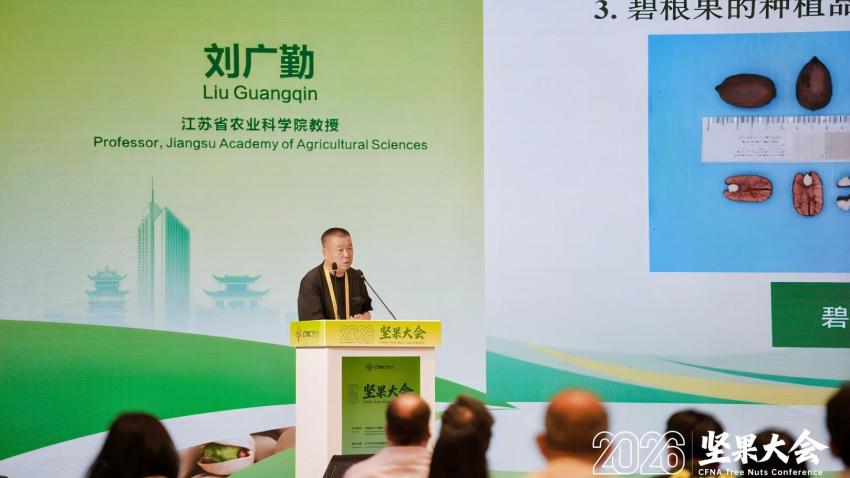
Professor Liu Guangqin from the Jiangsu Academy of Agricultural Sciences, a featured speaker at the conference and widely recognized as the pioneer of Jiangsu’s pecan industry, played a pivotal role in this transformation. His early research focused on apple cultivation, but he later recognized that Jiangsu’s climate and soil conditions offered limited competitiveness for traditional apples. Therefore, he shifted his focus to pecan cultivation, conducting in-depth assessments of regional climate, soil and market conditions before promoting pecan planting in Jiangsu. After more than two decades of research and farmer outreach, Jiangsu and Anhui provinces together now boast nearly 1 million mu (approximately 66,700 hectares) of pecan orchards, accounting for more than 80% of China’s total. This positions the region as China’s most concentrated and largest pecan production hub.
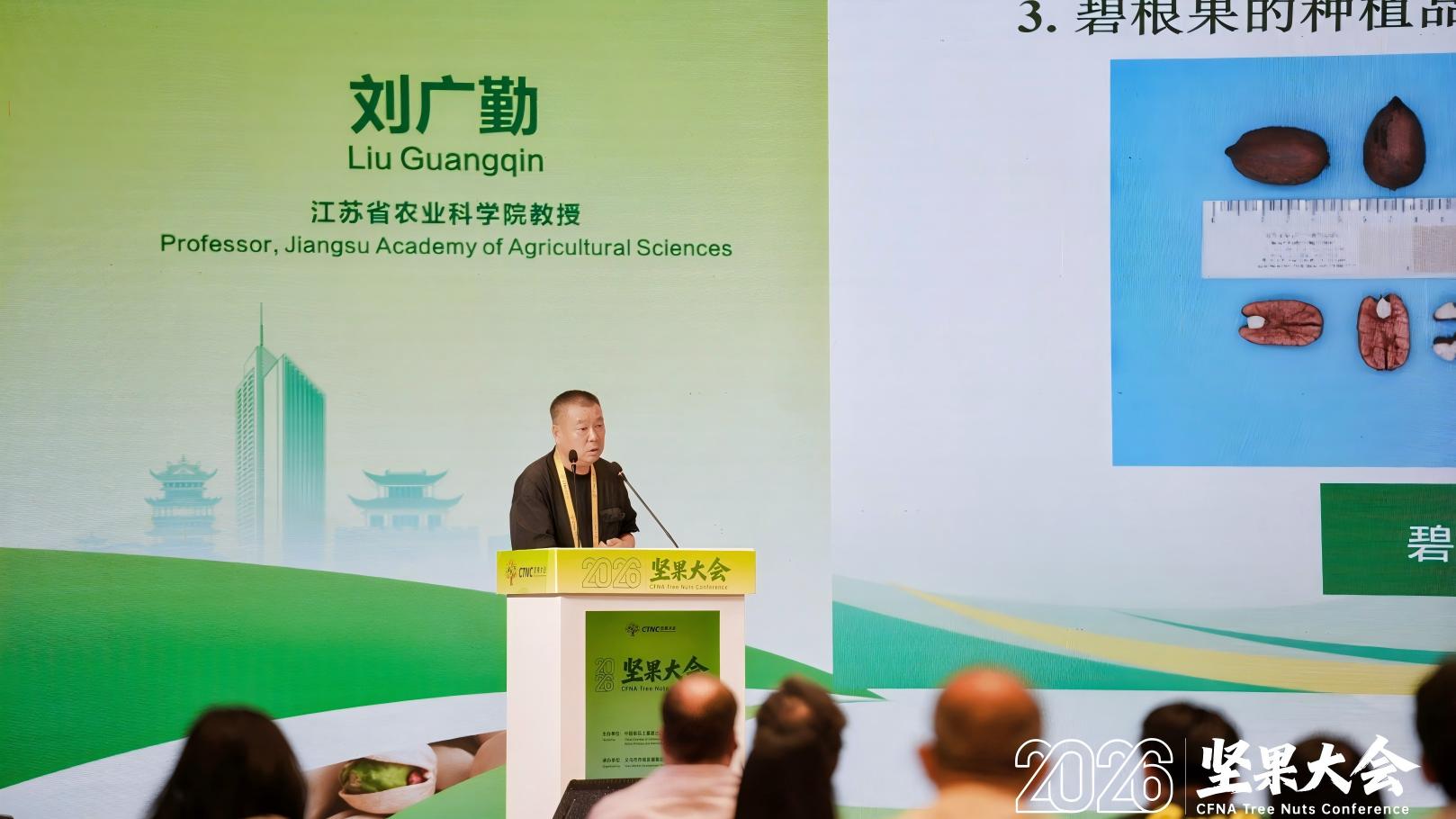
Chen Qingsheng, former president of the Jiangsu Academy of Forestry, observed that without Liu’s decades of dedication to pecan introduction, domestication and cultivation innovation, the pecan industry in Jiangsu province’s Sihong County would never have taken root. It was the proven success of Sihong as a pilot model that laid the groundwork for the large-scale pecan expansion now seen across Jiangsu and Anhui.
With improving tree maturity and number of bearing trees, domestic pecan production is expected to enter a sustained growth phase. At the same time, annual exports have risen steadily from 3,254 metric tons in 2024 and 3,312 metric tons in 2025 to 3,425 metric tons in the first half of this year alone. Industry insiders project that total exports for the full year could surpass 6,000 metric tons, signaling continued expansion into overseas markets.
The industry is developing a clear regional layout, with Jiangsu, Anhui and Yunnan provinces as the core production areas. A northward planting strategy is also gaining momentum, with Shandong province also accelerating its pecan acreage expansion. The sector has adopted a dual-variety framework of “Jinhua in the south, Pawnee in the north” optimized for regional conditions, with cultivar adjustments made to address scab disease resistance.
Chinese growers have developed innovative cultivation practices, including intercropping systems, high-light-efficiency tree training and tiered management models tailored to different orchard conditions. Mechanized harvesting and intelligent X-ray color sorting are also gradually being adopted across the sector, contributing to a refined, technology-driven production system.
Despite these advances, China’s pecan industry still faces critical bottlenecks with respect to post-harvest handling. Insufficient drying, storage and sorting infrastructure has contributed to higher spoilage rates. To address these challenges, the industry will continue to promote large-scale, standardized planting practices, improve processing infrastructure and advance mechanization across the entire production chain. With the northward expansion, varietal optimization and full-chain mechanization, the Chinese pecan industry is positioning itself to strengthen its foothold in the domestic market while simultaneously expanding its share of global exports.
Images: 2026 CFNA China International Tree Nuts Conference
